Sooner or later, every crane owner asks the same question: what is my machine really worth? And the answer is rarely the one they expect. Some overvalue it because they remember what they paid and what it cost to maintain; others sell it short because they do not know what the market will actually pay today. Both mistakes cost money.
The underlying problem is that a mobile crane is not valued like a car. There is no official table where you enter the plate and the year and out comes a figure. It is a niche, international market, with few buyers for any given machine, and in which the price is set by something very simple to state and very hard to measure: what a real buyer would pay for that crane, in that condition, with that paperwork, right now. In this article I will tell you what really moves that number and how we work it out before putting a machine up for sale.
The honest answer: no price table, there is a second-hand market
It is worth starting here to save you grief. The value of a used crane does not come out of a straight-line depreciation formula, though that can serve as a starting point. An older machine in good condition, well documented and of a sought-after make and model, can be worth more than a younger one of equivalent capacity but with the hours through the roof and maintenance done by halves.
What really rules is the market of comparables: the prices at which deals are closing on equivalent cranes — same make, model, tonnage and configuration, in similar condition — inside and outside Spain. That is the real starting point of any serious valuation. Everything else is adjustments on that reference, up or down, depending on what your machine has more or less of than those equivalent mobile cranes.
What raises and lowers your crane price
These are the factors we look at, in rough order of weight:
The make and model. Not all cranes depreciate the same way. Makes with a good reputation for reliability and, above all, with available spare parts and accessible service — Liebherr, in a prominent place, and then behind it makes such as Tadano, Demag and Grove — hold their residual value better. A discontinued model that is hard to repair loses appeal no matter how good a working and physical condition the machine is in.
Capacity and configuration. Tonnage rules, but it is not everything: boom length, the jib (fixed or luffing), the available counterweight and configuration extras (auxiliary hoist, runner, electric brake, etc.) widen the range of jobs the crane can do, and that is paid for. Two machines of the same model can differ considerably in price depending on how they are equipped.
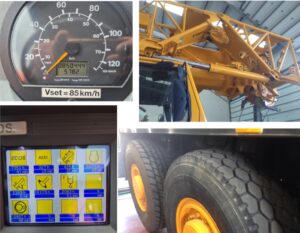
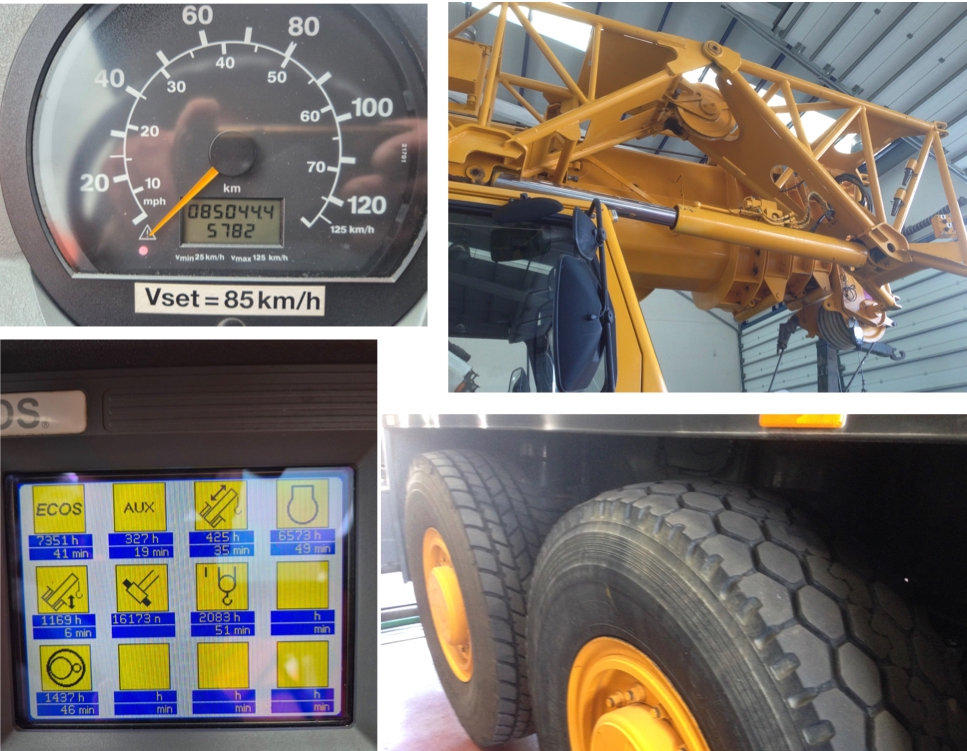
Year and hours. Here is a detail that someone coming from the car world tends to overlook: an all-terrain crane has two counters that buyers watch, the hours on the upper engine (the crane engine) and the kilometres on the chassis. A machine with few kilometres but many working hours, or the other way round, tells a story an experienced buyer knows how to read. The year matters, but well-balanced, consistent hours (around a thousand working hours per year is the norm) matter more.
The real condition. Boom and telescoping system, luffing cylinder, slewing ring, hoist and ropes, hydraulic system, both engines (chassis and crane), tyres, structural condition and the absence of corrosion. Everything that affects safety and what will have to be spent right after buying it enters the price. A crane that needs new ropes, serviceable tyres or a major repair is not worth the same, and the buyer will discount it with interest.
Paperwork and type-approval. This is an aspect most owners underestimate. A machine with its roadworthiness inspection (ITV) up to date, an orderly maintenance history and its paperwork in order is worth significantly more than the same crane with incomplete papers, simply because the buyer is buying peace of mind. And when European type-approval comes into play, the effect is large: I go into it in the guide to type-approval and registration of mobile cranes in Spain.
Optional equipment. Additional hoists, jibs, side extensions, electric brakes, air conditioning and other extras add value, as long as they are items the typical buyer of that model values.
And, on the other side, what takes value away without many people accounting for it: pending repairs, incomplete paperwork, very high hours for the machine age, corrosion, and belonging to a model whose spare parts are no longer easy to find.
Where the machine is located also counts
A point that gets forgotten: where the crane physically is affects what it is worth to a particular buyer. A machine already in the European Union, ready to be type-approved and registered, saves the buyer customs formalities and possible duties and, depending on the case, individual approval itself. That same crane on another continent, even if identical, is worth less to a Spanish buyer because it has all those costs and procedures ahead of it. I cover it in detail in the guide to importing a used crane from outside the EU.
That is why, when we value your machine, we do not just give a number: we give the number that makes sense for the buyer we are going to offer it to.
How we value a crane at KRANEX
If you take only one idea from this guide, let it be this: a reliable valuation is not an opinion, it is a market reference adjusted to your specific machine. This is how we do it:
- Exact identification of the machine. Make, model, year, configuration, the two usage counters (hours and kilometres) and equipment. The more precise this step, the more reliable everything else.
- Review of condition and paperwork. What has to be spent right after buying it and what documents back it up. This is where a crane gains or loses thousands of euros.
- Search for real comparables. The prices at which deals are closing on equivalent machines, in Spain and abroad — not inflated listing prices, which mostly come from searches on websites.
- Adjustment and range. We start from the market reference and adjust for what your crane has more and less of. The result is not a magic figure, but a realistic range with the recommended asking price.
Put another way: you tell us what machine you have; we tell you what the market will pay for it and why.
Selling on your own or through a broker
Valuing it well is the first step; selling it is the second. You can do it on your own, and for some owners that makes sense. But the crane market is small and scattered: the buyer for your specific machine may be in another country, and finding them — and filtering out those who only come to look or to haggle with no real intention — takes time and contacts. In the pillar guide on how to sell your mobile crane at the best price I go into both routes and when each one pays off.
Frequently asked questions
Can I find out what my crane is worth without anyone coming to see it?
A ballpark range can be given from the data alone (make, model, year, hours, kilometres, configuration and some photos). To firm up a solid asking price it is worth reviewing the real condition and the paperwork, because that is where much of the value is decided.
Why do two cranes of the same model and year have such different prices?
Because the year says little on its own. The hours, the condition, the configuration, the equipment and above all the paperwork separate two machines that look identical on paper.
Is the valuation a buyer gives me trustworthy?
A buyer values in order to buy cheap; that is legitimate, but it is not a neutral reference. A useful valuation rests on real market comparables, not on the interest of the person on the other side of the table.
How long does it take to sell a crane once it is valued?
It depends on the model and on demand at the time. A sought-after machine, well valued and well documented, moves briskly; a poorly valued one sits idle and ends up selling for less. Setting the right price from the start is what most speeds up the sale.
Does it affect the value for the crane to be registered and with its ITV up to date?
Yes, quite a lot. It reduces the buyer uncertainty and saves them procedures, and that translates into price.
Want to know what your crane is worth?
Tell us what machine you have — make, model, year, hours, kilometres and a couple of photos — and we will give you a realistic valuation based on what the market is paying today, with no obligation. And if you decide to sell, we will take care of finding the right buyer.
Talk to us and we will look at it. And if you would also like to see what is moving, take a look at our mobile cranes for sale.