A mobile crane isn’t just heavy machinery: it’s at once a special vehicle that drives on the road and a piece of work equipment. That dual nature is what makes its paperwork more of a headache than you’d expect, and why it’s worth being clear about which documents it needs before you buy, before you sell or, simply, before you take the machine out onto the road.
In this article we’ll run through, without unnecessary jargon, the paperwork a self-propelled crane needs to be in order in Spain: the vehicle’s documents, the permits required to drive it, the operator’s licences, and the documents that prove the machine is fit to work. The more specific side of type-approval and registration is covered in the guide to type-approval and registration of mobile cranes in Spain; here I focus on the day-to-day documentation as a whole.
For traffic purposes, a mobile crane is a special vehicle
The first idea to settle: a self-propelled crane is registered and treated as a special vehicle. It isn’t an ordinary truck, nor a machine that only lives inside a site. It drives on public roads with its own plates, and so it carries the same documentary obligations as any vehicle, plus those that come with its size and weight.
That has a practical consequence: when a machine’s paperwork is incomplete or disorganised, the problem isn’t only administrative. It can stop the crane from moving legally, delay a delivery and, when it comes to a sale, sink the deal or push the price down. We see it often, and I cover it in the guide to how much a used mobile crane is worth: paperwork in order is part of the value.
The vehicle’s documents
This is the documentation that travels with the machine:
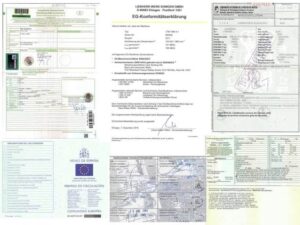
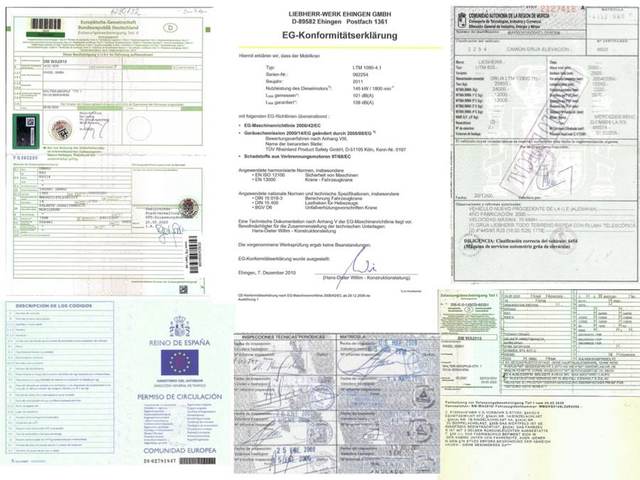
Registration certificate. It proves who the owner is and that the vehicle is registered with the traffic authority (DGT).
Technical data sheet (roadworthiness card). It records the crane’s technical characteristics and its approved modifications. Anything changed from the original — and on these machines that’s common — must be reflected here.
Valid roadworthiness test (ITV). As a special vehicle, the crane must pass its periodic inspections and keep the corresponding certificate up to date. An expired ITV is one of the silliest — and most frequent — reasons a machine can’t go out to work.
Compulsory insurance. The vehicle’s third-party liability insurance, valid and appropriate to its use.
Certificate of Conformity (COC) or type-approval. The documentation proving the machine is approved to drive in Spain. If it comes from abroad, this is where the whole process I explain in the guide to importing a used crane from outside the EU comes into play.
What it takes to drive on the road
This is where a crane parts ways with other vehicles. Because of their dimensions and mass, many machines exceed the ordinary limits for driving, and that calls for specific abnormal-transport authorisations to move on public roads.
Depending on the case, that can mean an authorisation to circulate as a special-transport vehicle, the required signage (panels, beacons), time and route restrictions and, for the most demanding moves, escort vehicles. Not every crane needs this to the same degree: it depends on its configuration and how it travels (with or without counterweights and jib fitted). The sensible rule is to confirm which authorisation applies to that specific machine before scheduling a move, not once it’s already on the road.
The operator’s documentation and driving
Having the machine in order isn’t enough if whoever drives or operates it isn’t:
The right driving licence. To drive the crane on the road you need the licence that matches the vehicle’s mass and characteristics.
Operator training. Operating a mobile crane is a high-risk activity and is subject to occupational-safety rules: the operator must have the training and competence required for the safe use of the equipment. It isn’t something you improvise, and in a sale it’s worth keeping in mind for the team that will operate the machine.
The documents proving the machine can work
Beyond being able to drive, the crane has to be fit to work safely, and that is documented too:
Servicing and maintenance. An orderly maintenance history isn’t just good practice: it backs up that the machine has had the care it needs and is one of the first documents a serious buyer asks for.
Inspections of the machine as work equipment. Cranes, as lifting equipment, are subject to periodic checks of their critical elements — structure, ropes, safety system and load moment limiter. Keeping these records up to date avoids nasty surprises and attests to the machine’s real condition. This includes the periodic technical inspection (ITGA) by a nationally authorised certification body (OCA).
None of these documents is a minor formality. Together, they’re what lets a crane go from parked to earning.
Why this matters when buying or selling
When we broker a deal, the paperwork is one of the first things we review, for a very concrete reason: a machine with its papers in order sells better, faster and at a higher price, while one with incomplete documentation breeds mistrust. If you’re thinking of buying, it’s part of what you have to check, as I explain in how to buy a used mobile crane without surprises. And if you’re thinking of selling, getting the papers in order before putting it on the market is one of the most profitable uses of your time.
How we see it at KRANEX
Drawing on our long experience in mobile crane trading, we know the paperwork is as decisive as the mechanical condition. That’s why, when we accompany a deal, we check that the machine has its vehicle documents in order, that the type-approval and modifications are correctly reflected, and that its situation for driving and working is what the buyer expects. The aim is simple: no surprises after the deal is done.
Frequently asked questions
Is a self-propelled mobile crane registered like a truck?
Not exactly. It’s registered and treated as a special vehicle, with its own obligations for roadworthiness testing, driving authorisations and the characteristics on its technical data sheet.
Do I need a special authorisation every time I move the crane?
It depends on the machine’s dimensions and mass and on how it travels. Many cranes exceed the ordinary limits and require an abnormal-transport authorisation; it’s worth confirming for that specific machine before each demanding move.
What happens if I buy a crane with an expired ITV or incomplete papers?
You won’t be able to move it legally until it’s regularised, and that administrative work has a cost in time and money. That’s why it’s worth reviewing the documentation before buying and discounting it from the price if need be.
Does documentation affect resale value?
A lot. A machine with its papers in order and maintenance up to date sells better and for more than the same crane with half-finished documentation.
Can you help me review a machine’s documentation?
Yes. Whether you’re buying or selling, reviewing the state of the paperwork is part of what we do on every deal.
Questions about your crane’s paperwork?
Whether you’re buying, selling or simply want to make sure your machine is in order, tell us your case and we’ll point you the right way. And if you’re after a crane with its paperwork in order and ready to work, take a look at our mobile cranes for sale.
Talk to us and we’ll look at it with no obligation.