The term “mobile crane” covers very different machines, designed for different jobs. Choosing the right category comes first — before the brand or the price: a well-chosen crane performs and is safe; a poorly chosen one either falls short or is money wasted on capacity you never use. This is the guide to the main categories, what each is for and how to decide.
All-terrain crane
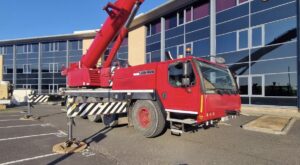
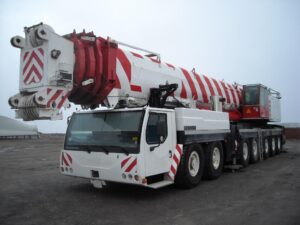
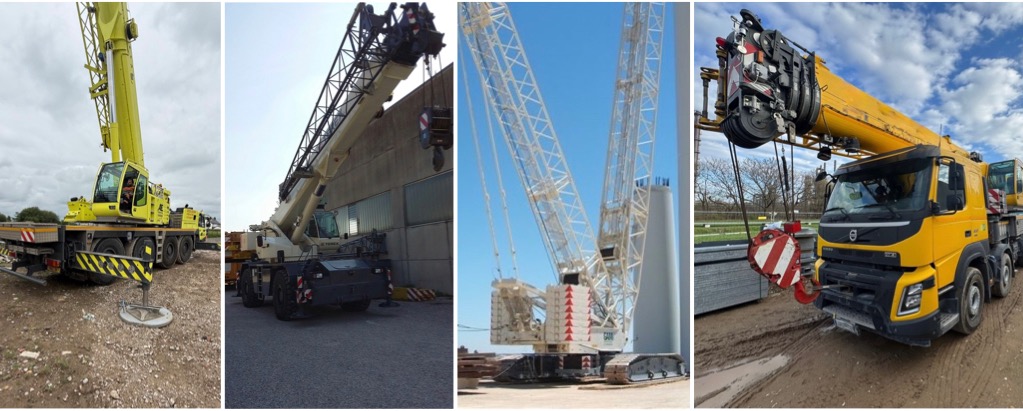
This is the most versatile mobile crane and the most common on the market. It sits on a multi-axle chassis that lets it travel on the road at truck speed while also moving around a rough job site. It combines mobility and lifting capacity across a very wide range, from compact machines to heavy lifting units on chassis of up to 9 axles.
When it fits: jobs that require travelling by road between different sites and operating in varied rough locations. It is the default choice for most lifts, and that is why it is also the most sought-after on the used market.
Crawler crane
Instead of wheels, it moves on tracks and works on them, with no need for an additional outrigger base like other mobile crane types. That gives it exceptional stability and the ability to work — and even travel under load — on soft or uneven ground where a wheeled crane could not go. In return, it does not travel on the road under its own carrier: it has to be transported dismantled and assembled on site, which adds logistics and transport cost. It usually carries lattice booms rather than telescopic ones, with far greater resistance to deformation than the latter.
When it fits: large projects with high-tonnage pieces (heavy lifting), long-duration assembly at a single location, in both industry and construction (refineries, power plants, chemical plants, port infrastructure), and high-level assembly work on difficult ground (wind turbines). It is common in energy, infrastructure and wind-turbine assembly, where it stays weeks or entire months at the same site.
Truck-mounted crane
This is a crane mounted on a truck chassis. Road mobility and rapid deployment come first: it arrives, sets up and works. It usually operates in lower load ranges than an all-terrain crane of equivalent size, in exchange for that agility to get around.
When it fits: loading and unloading jobs, quick set-ups and tasks where arriving fast and deploying matters more than maximum capacity. Very useful when it means covering long distances very frequently.
Rough-terrain crane (RT)
Designed specifically to move within the site on uneven ground. It runs on four large off-road tyres, is compact and highly manoeuvrable, but does not travel on the road: it is carried to the site on a suitable low-loader. Its top speed is usually around 45 km/h. Its price is on average much lower than its equivalent all-terrain crane.
When it fits: intensive work within a single enclosure — site, industry or port — with rough ground and limited space, where its compact size and manoeuvrability are an advantage over larger machines. Also as a yard crane, when a long stay in an enclosure is required to move loads from point to point, even while travelling.
Other variants of the above
For more specific applications there are lattice-boom cranes on a truck chassis (TC or LG types depending on the manufacturer); telescopic-boom cranes on a crawler chassis (LTR); self-erecting tower cranes on a truck chassis (Spierings or Liebherr MKs); and compact CityClass cranes, a variant of the fast all-terrain crane that essentially has a single cab and can work with the boom fully horizontal, making them extremely useful in very tight indoor spaces.
Beyond all this, you can also find other crane types for almost strictly industrial use, mini-cranes (spider type), trailer-mounted construction cranes and so on, which are not covered in this article and which we may address in future posts.
How to choose the crane for the job
The category comes from combining four variables:
- Load and reach: the weight, height and radius you need to reach.
- Ground: firm or uneven, compact or soft.
- Mobility: does it have to travel by road between sites, or does it stay in one place?
- Duration: a one-off job or continuous work at one location.
With that clear, the decision almost makes itself: if the job requires a lot of travelling, all-terrain or truck-mounted; if it is high tonnage fixed on difficult ground, crawler; if it is intensive work within an uneven enclosure, rough terrain. From there, the choice of brand and model — Liebherr, Terex-Demag, Grove, Tadano (today’s Demag) and others — follows naturally, and we fine-tune it according to budget, availability and the condition of the machines on the market.
Frequently asked questions
What is the most versatile mobile crane? The fast all-terrain crane, because it combines road travel with the ability to work on difficult sites. It is the default choice for most jobs.
What is the difference between a crawler crane and an all-terrain crane? The crawler is more stable and works on difficult ground and high tonnages, but it is not designed to move much around the workplace — it has to be transported and assembled before starting; the all-terrain crane travels between sites on its own.
What is a rough-terrain crane? A compact, manoeuvrable crane for working within the site on uneven ground. It does not travel on the road: it is transported to the location.
How do I know which type of crane I need? By combining load and reach, ground, mobility and duration of the job. If you are unsure, we advise you based on your specific operation.